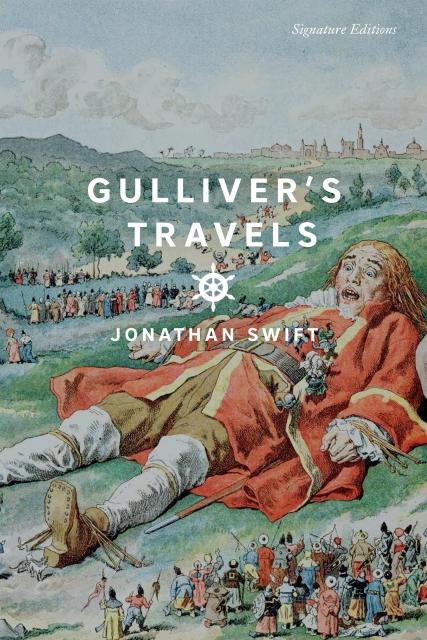
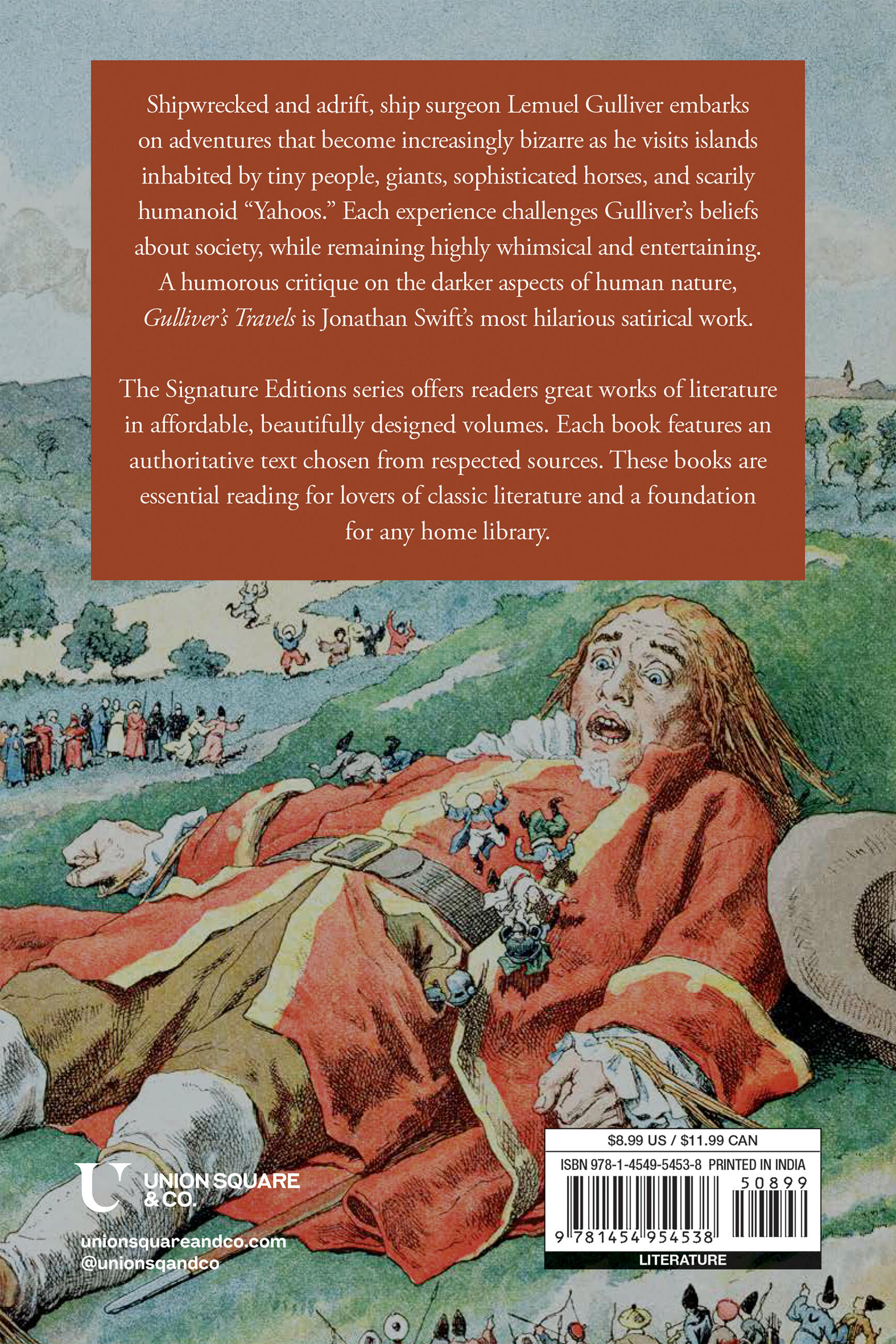
Following ship surgeon, Lemuel Gulliver, Jonathan Swift’s satire, Gulliver’s Travels, is a humorous critique of the darker aspects of human nature. During his voyage, Gulliver visits four islands, each more bizarre and fantastical that the last. From tiny people to giants, from majestic horses to scarily humanoid “Yahoos,” each of the island inhabitants create an experience that no one is likely to forget.
Jonathan Swift (1667-1745) was an Anglo-Irish satirist, essayist, political pamphleteer (first for Whigs, then for Tories), and poet, famous for works like Gulliver's Travels, A Modest Proposal, The Journal to Stella, The Drapier's Letters, The Battle of the Books, and A Tale of a Tub. Swift is probably the foremost prose satirist in the English language, and is less well known for his poetry. Swift originally published all of his works under pseudonyms—such as Lemuel Gulliver, Isaac Bickerstaff, M. B. Drapier—or anonymously. He is also known for being a master of two styles of satire: Horatian and Juvenalian.
Jonathan Swift (1667–1745) was born in Dublin. In 1692, Swift published his first work, a poem called “Ode to the Athenian Society.” Later, in the early 1700s, Swift became active in London politics. Although Swift published many works, he is best known for Gulliver’s Travels and the satirical pamphlet “A Modest Proposal.”